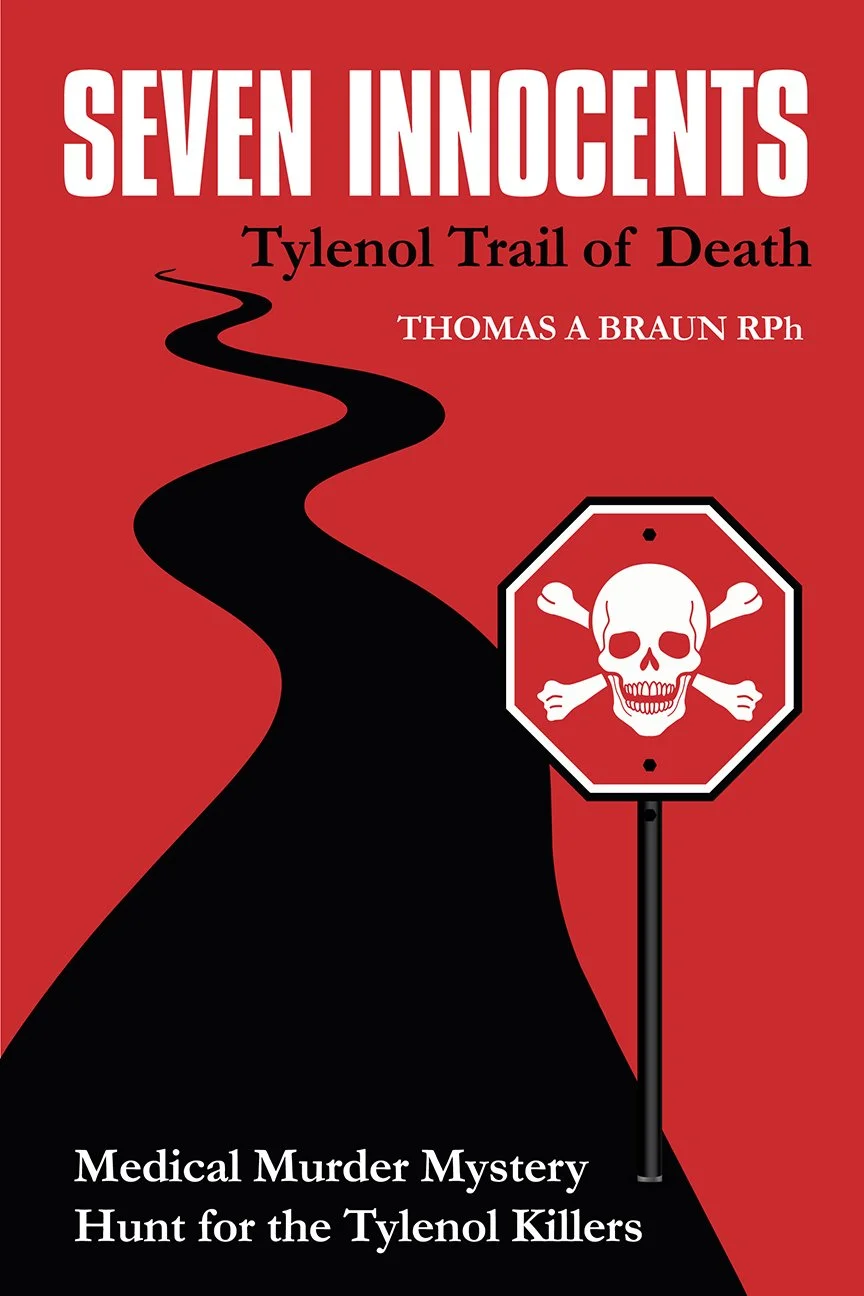
Seven Innocents
Tylenol Trail of Death
“I'm so thrilled for you that this book is finally coming to fruition.
I'll be one of the first people to buy it.”
— Jamie Bartosch, veteran Chicago Reporter
"The Tylenol murders were the perfect crime. They have no evidence.”
— Commander Brzeczek, Chicago Chief of Police
The body count was higher.
The FBI chased the wrong man for a lifetime.
On October 9th, Unsolved Mysteries will reveal that part of the Tylenol cyanide mystery has finally been solved.
Cold Case Detective Timothy Cooper of the Ada County Sheriff's Office in Boise, Idaho identified the man who died in a Catholic church in December 1982 — 44 years later. A key. A DNA match. Decades of patient detective work.
On December 4th, 1982, a man was found face down across the kneeler of Sacred Heart Catholic Church. He carried $1,900 in hundred-dollar bills, a well-worn wallet, no car keys, no wedding ring, and no identification. He wore cowboy boots, a Seiko watch, and a silver-and-turquoise Navajo bolo tie. He was impeccably groomed. He did not die poor.
His suicide note — typewritten, no errors — ended in a sentence no one could read.
In Seven Innocents: Tylenol Trail of Death, I devote a chapter to this man and to the theory that he was the forerunner of what followed — a man who erased his past to spare his family shame.
It was an eight-year span, 1979 to 1986, that permanently changed how every consumable product in America is packaged.
******
The author’s original research journey was to prove that revenge was the motive for the poisonings of Seven Innocents on September 29th. 1982 in Chicago. He believed it was a singular event until he questioned anomalies that proved otherwise. AI became a research tool that further detailed events at first glance which seemed isolated, but in reality, were connected.
The end result is a fascinating story of why there were multiple killers using Tylenol capsules as the instrument of death. None of the killers have ever been identified, but the facts uncovered may lead the FBI to finally identify some of the killers. The author invites mystery readers, medical and legal professionals to learn what really transpired over an 8 year period. The first cyanide Tylenol death occurred in 1979 and the last in 1986.
The result was tight controls on the purchase of cyanide and all consumer consumable packaging was mandated to have tamper resistant features to prove to the purchaser that the product is safe.
In summary:
Seven Innocents tells the true story of Johnson & Johnson’s Tylenol crisis starting in the late 1970s and spanning eight years. It also shines a light on how corporate goals sometimes cause intelligent and successful pharmaceutical executives to cross the line and allow faulty drug research and aggressive marketing to become instruments of death. Drug related death events are not unique to J&J prescription products.
The positive aspect is that almost all consumable products today have tamper resistant features that alerts the buyer to the safety of the product. J & J’s tamper resistant patent design development was adapted in some form to most products today.
“McNeil Tylenol factory in Fort Washington stocks Potassium Cyanide in their testing laboratory."
— Gardiner Harris, author of No More Tears
*****
"The FBI and the Police will not release documents that were created from interviews with J & J executives."
— Netflix documentary Cold Case: The Tylenol Murders
*****
“We interviewed David Collins, the then chairman of McNeil Consumer Products, over a Zoom video call and he got very emotional and cried.”
— Christy Gutowski, Chicago Tribune Investigative journalist.
*****
"Your work stands as a searing indictment of corporate greed and the FDA's failure to serve as a watchdog, as well as a commentary on the human tendency to fix on a particular approach to the exclusion of other possibilities”
— Thomas Rosenwein, Attorney at law. My guiding light.
Click on the Newsletter Icon or go to the contact page to sign up and stay informed as to when you may pre order your book. Launch date for the book is September 29th, 2026. In addition, the newsletter will inform all who sign up what is transpiring by law enforcement to follow the leads that have been uncovered to find the multiple killers. Stay informed!